Category: Uncategorized

  • The Ultimate Guide to Buying in Maryland in 2026: Everything You Need to Succeed

    The Ultimate Guide to Buying in Maryland in 2026: Everything You Need to Succeed

    If you’ve been watching the Maryland real estate market over the last few years, you know one thing for certain: the only constant is change. Moving into mid-2026, the "wild west" atmosphere of the early 2020s has shifted into something new. We are no longer seeing the frantic, blind bidding wars of the past, but we aren't in a "down" market either.

    📬 Join the Inner Circle — Get weekly Maryland market updates straight to your inbox. Most buyers don't know what's coming. You will. Subscribe now and get the unfair advantage.

    What we have today is a market of clarity and cautious opportunity.

    For buyers in the Old Line State, success in 2026 isn't about moving fast: it’s about moving smart. It’s about understanding the data, knowing your "walk-away" number, and having a clear strategy for the specific neighborhood you’re targeting. Whether you’re looking at a townhome in Howard County or a single-family home in the suburbs of Baltimore, this guide is designed to empower you with the facts you need to navigate the current landscape with confidence.

    The 2026 Maryland Market Pulse: What the Data Says

    Understanding the macro environment helps you set realistic expectations before you ever step foot in an open house. As of June 2026, here is the state of play in Maryland:

    • Median Sale Price: The median home price in Maryland is currently hovering around $448,407. While prices are up about 2.4% year-over-year, the rate of growth has stabilized. We are seeing a market that appreciates at a healthy, sustainable pace rather than the double-digit spikes of previous years.
    • Inventory Levels: We currently have roughly 25,000 active listings across the state. This represents about a 3-month supply of homes. For context, a "balanced" market usually has a 6-month supply. This means sellers still have a slight edge, but buyers have significantly more choice than they did two years ago.
    • Days on Market (DOM): The median time a home stays on the market is now about 43 days. This is a crucial metric for you as a buyer. It means you actually have time to breathe, think, and perform due diligence before making an offer.
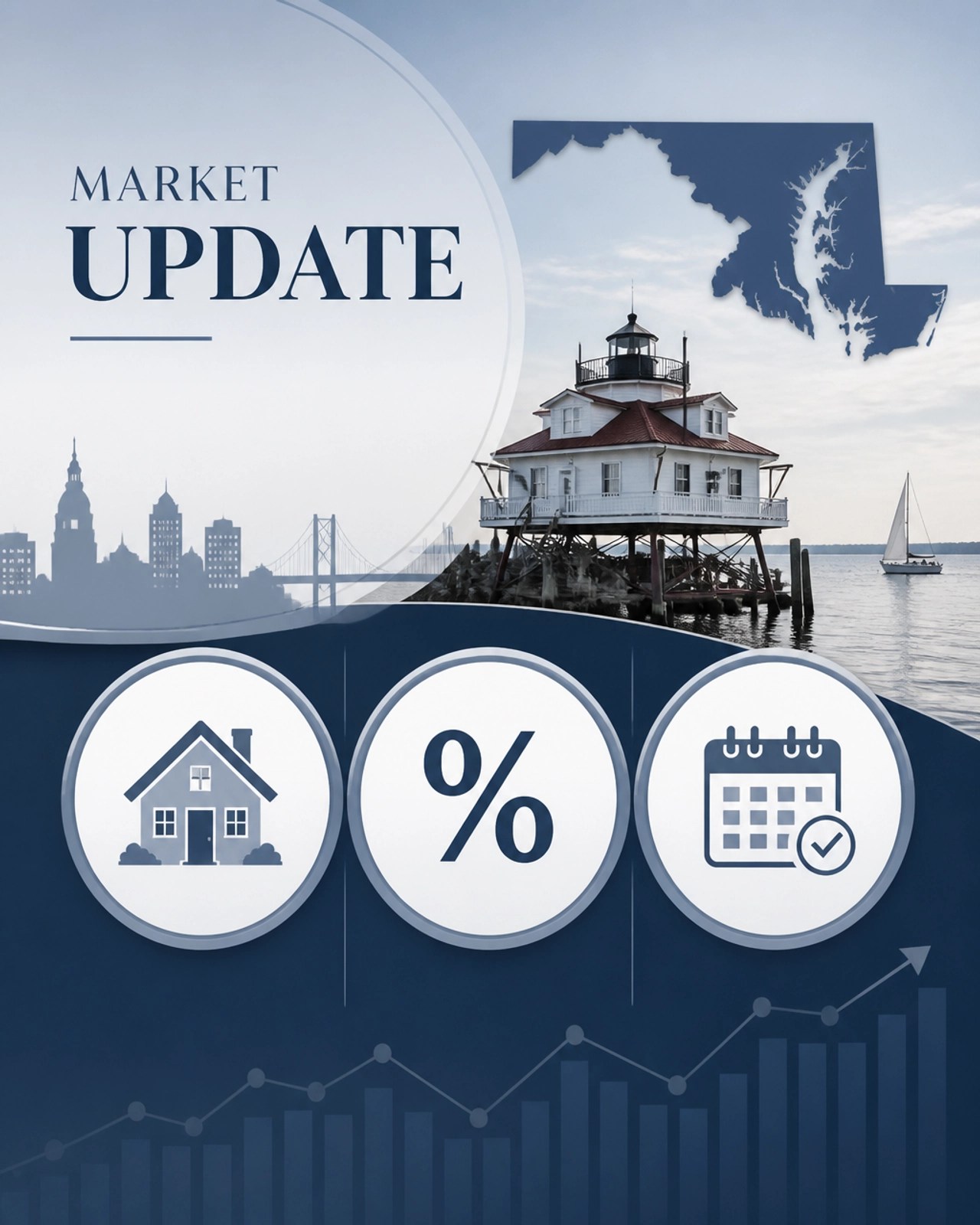
    Maryland Real Estate 2026 Market Update Graphic

    Step 1: Shift Your Focus from "Price" to "Payment"

    In 2026, the most successful buyers aren't just looking at the sticker price of a home; they are obsessed with the monthly payment. With mortgage rates for conventional loans currently ranging between 6.3% and 7.0%, your borrowing power is different than it was when rates were at historic lows.

    Why the Monthly Number Matters

    When you focus solely on the purchase price, you might miss the impact of Maryland’s specific property taxes or varying HOA fees. A $450,000 home in one county might have a vastly different monthly carry than the same price point in a neighboring county.

    As a liaison to the process, I always encourage buyers to work closely with their mortgage professional to establish a "payment ceiling." This ensures that when we find a property that fits your lifestyle, the numbers also fit your long-term financial clarity. We want you to love the home and the lifestyle it allows you to lead.

    Step 2: Leverage the "Price Improved" Opportunity

    One of the most interesting shifts in 2026 is the return of the Price Reduction. About a third of homes in Maryland are still selling above list price, but that means two-thirds are not.

    A For Sale sign with a Price Improved rider in a Maryland neighborhood

    When a home has been on the market longer than the 43-day median, it often signals an opportunity for negotiation. In 2026, "stale" listings are often just homes that were slightly over-ambitious with their initial pricing. These properties can be gems for buyers who are willing to look past a "Days on Market" counter and instead focus on the underlying value of the asset.

    Strategic Negotiation

    Unlike the 2021 market where buyers were waiving inspections and appraisals, the 2026 market allows for more traditional protections. We are seeing a return to:

    • Home Inspection Contingencies: Ensuring the "bones" of the house are solid.
    • Appraisal Gaps: Becoming less common as pricing stabilizes.
    • Seller Concessions: Asking for help with closing costs or interest rate buy-downs is back on the table in many Maryland sub-markets.

    Step 3: Understanding Regional Micro-Markets

    Maryland is often called "America in Miniature," and our real estate market reflects that. You cannot apply a "one size fits all" strategy to the entire state.

    The DC Commuter Corridor (Montgomery & Prince George’s Counties)

    Inventory remains tightest here. Competition is still high for properties near Metro stations or major commuter routes like I-270 and the Beltway. If you are looking in these areas, your offer needs to be clean and your pre-approval must be rock solid.

    The Baltimore Suburbs (Anne Arundel, Howard, & Baltimore Counties)

    These areas are seeing some of the healthiest inventory growth. Families looking for more space are finding more options in places like Millersville, Gambrills, and Columbia. You can view some of the current local opportunities and styles in these areas by visiting Lamont Milbourne’s Real Estate Portal.

    The "Slower" Markets

    In more rural or distant suburbs, days on market can stretch beyond 60 days. For a patient buyer, these areas offer the greatest potential for price negotiations and seller-funded repairs.

    Step 4: The Importance of Professional Guidance

    Buying a home is likely the largest financial transaction of your life. In a market that is "easing but still competitive," having a liaison who understands the nuances of Maryland contracts and local trends is vital.

    My role at K-Stone Enterprises is to act as your information resource. Whether you are a first-time buyer trying to understand the process or an experienced homeowner looking to level up, I focus on providing the education and deal analysis support you need to make an informed decision.

    Professional real estate consultation session

    We don't believe in pressure or "hype." We believe in data, strategy, and clear next steps. You can learn more about my background as a U.S. Army veteran and licensed Maryland real estate professional on my About Page.

    Moving Forward with Clarity

    The Maryland market in 2026 offers a unique window for those who have been waiting on the sidelines. Inventory is up 12% over last year, giving you more choices than we’ve seen in a long time. While rates are higher than the 3% era, they have stabilized, allowing you to plan your budget with certainty.

    The key to succeeding this year is simple: Don't guess. Know.

    Know your budget, know your neighborhood, and know what a "good deal" looks like for your specific situation. If you see a property that catches your eye, or if you want to start the conversation about what's available in your target area, let’s get the information you need.

    Want this kind of insight every week? Join the Inner Circle — it's free and it keeps you ahead of the curve in the MD market.

    Send me the property address or basic details and I’ll let you know what information would be needed for the next step.

    Reply “INFO” and I’ll send the next step.

    🧵 Check out Twisted Emotions (Threaded Creations KLM) on Etsy — unique, handcrafted apparel that lets you wear your story. Browse the shop here: https://threadedcreationsklm.etsy.com


  • 7 Mistakes You’re Making with Your Household Debt (and How to Fix Them)

    7 Mistakes You’re Making with Your Household Debt (and How to Fix Them)

    Let’s be real for a second: debt isn’t just a number on a screen. It’s a weight. It’s that low-level hum of anxiety that kicks in when you open your banking app or see a letter from a creditor in the mail.

    As we move through 2026, the financial landscape has shifted. According to recent data, total U.S. household debt has climbed to a staggering $18.8 trillion. If you feel like your balances are creeping up faster than your paycheck, you aren't alone. In Maryland specifically, we’ve seen some of the sharpest increases in consumer debt in the nation, with average credit card balances hitting nearly $12,500 per household in some areas.

    But here’s the good news: debt doesn’t have to be a life sentence. Most of the "stuck" feeling comes from a few common, repeatable mistakes that almost everyone makes. When you identify the mistake, you can fix the strategy.

    At K-Stone Enterprises, we believe in financial clarity. You can’t win a game if you don’t know the rules or where you are on the field. So, let’s pull back the curtain on the seven biggest mistakes people are making with their household debt right now and how you can start moving toward a smarter path.

    📬 Join the Inner Circle — Get weekly financial clarity insights straight to your inbox. Most people don't know what's coming. You will. Subscribe now and get the unfair advantage.

    🗳️ Poll: What's your biggest money stress right now?

    Be honest — knowing where you're at is the first step. Drop your answer below!

    A) Credit card debt and high interest rates
    B) Not knowing where my money goes each month
    C) Feeling stuck — no idea where to start
    D) Actually feeling pretty good — just here for the tips

    1. The Minimum Payment "Treadmill"

    Illustration of the minimum payment treadmill where the belt is made of credit cards and bills.

    This is the most common trap in the book. You get your credit card statement, see a $5,000 balance, but the "Minimum Payment Due" is only $125. It feels manageable, so you pay it and move on.

    The problem? Paying only the minimum is like trying to run a marathon on a treadmill that’s moving backward. Because of how interest is calculated, a huge chunk of that $125 goes toward the interest, not the actual debt. In some cases, it can take 20+ years to pay off a single balance if you only stick to the minimums.

    How to Fix It: Awareness is your first weapon. Look at your statement, by law, they have to show you how long it will take to pay off the balance if you only pay the minimum. It’s usually a wake-up call. Aim to pay even $20 or $50 above the minimum. Every extra dollar goes directly toward the principal, which reduces the amount of interest you’re charged next month.

    2. Ignoring the "Interest Vampire"

    Interest rates in 2026 are no joke. Many credit cards now carry APRs north of 20% or even 25%. If you aren't looking at those rates, you are essentially letting an "Interest Vampire" bleed your bank account dry every single month.

    When you ignore the rate, you lose the ability to prioritize. Not all debt is created equal. A 4% mortgage is a completely different animal than a 28% store credit card.

    How to Fix It: List out every debt you have, from highest interest rate to lowest. This gives you a clear target. You don't necessarily have to pay them all off at once, but you should know which ones are costing you the most to keep around. Education on interest awareness is the first step to stopping the bleed.

    3. Delinquency Denial

    With auto and credit card delinquency rates hitting 16-year highs this year, many people are choosing the "Ostrich Strategy", sticking their head in the sand and hoping the problem goes away.

    Ignoring a late payment or a collection notice doesn’t make it disappear; it makes it more expensive. In Maryland, debt collection practices can be aggressive. Once a debt moves into the legal or collection phase, your options for negotiation shrink, and the fees start to stack up.

    How to Fix It: Face the mail. If you’re falling behind, the best thing you can do is seek education on your rights and the status of your accounts. Knowing exactly where you stand with your creditors allows you to make informed decisions rather than reactive ones.

    4. Using Credit to Fill the Lifestyle Gap

    A motivational finance graphic asking about the importance of debt elimination and keeping more of your paycheck.

    Many households use credit cards to bridge the gap between their income and their lifestyle. Maybe it’s a dinner out, a new gadget, or even just groceries because the checking account is low.

    When you use debt to fund daily life without a plan to pay it back immediately, you’re essentially borrowing from your future self. You're trading tomorrow’s freedom for today’s comfort.

    How to Fix It: This mistake usually points to a need for better cash flow awareness. Instead of reaching for the plastic, ask: "Do I have the cash for this?" If the answer is no, it’s an opportunity to review your household budget and see where your money is actually going. Small shifts in awareness can lead to big changes in debt habits.

    5. The 84-Month Auto Loan Trap

    Cars are more expensive than ever, and to make the monthly payments "affordable," many lenders are pushing 72-month or even 84-month loans.

    While the monthly payment looks small, a 7-year loan on a depreciating asset is a recipe for "negative equity." This means you owe more on the car than it’s worth for almost the entire life of the loan. If you need to sell the car or if it gets totaled, you’re stuck with a "gap" you have to pay out of pocket.

    How to Fix It: When shopping for a vehicle, look at the total cost of the loan, not just the monthly payment. Be conservative with your targets. A shorter loan might mean a higher monthly payment, but it also means you’ll actually own the asset sooner and pay significantly less in interest over time.

    6. The "Invisible" Debt-to-Income (DTI) Ratio

    A magnifying glass bringing clarity to organized financial documents.

    Your Debt-to-Income ratio is a number that lenders use to decide if they’ll give you a mortgage or a business loan. Many people have no idea what theirs is until they get rejected for a loan they really need.

    If more than 36-43% of your gross monthly income is going toward debt payments, you are in the "danger zone." This high DTI makes you a "risky" borrower, which usually leads to higher interest rates on future loans: creating a cycle that’s hard to break.

    How to Fix It: Calculate your DTI today. Add up all your monthly debt payments (rent/mortgage, cars, credit card minimums, student loans) and divide that by your gross monthly income. If the number is high, your goal shouldn't just be "paying off debt," but "lowering your DTI." This creates the clarity needed to improve your financial standing.

    7. The "Lone Wolf" Strategy

    The biggest mistake of all? Trying to figure it all out by yourself. Financial education isn't taught in most schools, yet we're expected to navigate complex interest rates, tax awareness, and credit education on our own.

    Many people feel a sense of shame about their debt, so they keep it a secret. They try to out-earn their bad habits, but without a fundamental shift in financial education, the cycle usually repeats.

    How to Fix It: Seek resources. There is a whole world of financial education designed to give you clarity on credit, taxes, and debt. You don't have to be a math genius to master your money; you just need access to the right information and a clear path forward.

    A promotional graphic for the S.I.M.P.L.E Leverage Everything event focusing on wealth protection and leverage.

    Moving Forward with Clarity

    Debt doesn't have to be your identity. It’s just a financial state, and states can change. By avoiding these seven common mistakes, you’re already ahead of the curve.

    The goal isn't just to "get out of debt": it's to gain the education and awareness so that you never end up back in the same cycle. Whether it’s understanding how your credit works, becoming more aware of your tax obligations, or learning how to negotiate your monthly bills, every bit of knowledge adds up to more freedom.

    At K-Stone Enterprises, we are committed to being your liaison to the resources that help you move smart with understanding and clarity.

    Want this kind of insight every week? Join the Inner Circle — it's free and it keeps you ahead of the curve.

    Review the information here when ready: www.mwrfinancial.com/krnrstn21

    Want me to send you the information so you can review how it works?

    🧵 Check out Twisted Emotions (Threaded Creations KLM) on Etsy — unique, handcrafted apparel that lets you wear your story. Browse the shop here: https://threadedcreationsklm.etsy.com

  • Selling to an Investor vs. Listing on the MLS: Which Is Better For Your Maryland Home?

    Selling to an Investor vs. Listing on the MLS: Which Is Better For Your Maryland Home?

    Deciding to sell your home is one of the biggest financial moves you’ll ever make. In Maryland’s 2026 real estate market, that decision comes with a new set of layers. We aren't in the "wild west" market of a few years ago, but inventory is still tight and buyers are still hungry for the right property.

    📬 Join the Inner Circle — Get weekly Maryland market updates straight to your inbox. Most sellers don't know what's coming. You will. Subscribe now and get the unfair advantage.

    When you’re ready to move, you generally find yourself at a fork in the road: Do you list the home on the Multiple Listing Service (MLS) with a professional agent, or do you take the direct route and sell to a real estate investor?

    Neither choice is "wrong," but one is likely much better for your specific goals. My goal today is to give you the clarity and understanding you need to move smart. No hype, no pressure: just the facts about how these two paths play out in our local market.

    The 2026 Maryland Market Snapshot

    To make a smart move, you have to know what the ground looks like right now. As we move through 2026, Maryland is seeing a steady, healthy market.

    • Price Growth: We’re seeing a modest appreciation of about 2% to 4% statewide. It’s not a "bubble," but it’s certainly not a crash.
    • Inventory: Supply remains tight, hovering around 3 months. This means sellers still hold a fair amount of leverage because there are more buyers than there are available houses.
    • Time on Market: On average, homes are sitting for about 35 to 46 days before going under contract.

    With that context, let’s look at your two main options.

    Option 1: Listing on the MLS (The "Top Dollar" Path)

    Listing on the MLS is the traditional way to sell. When your home is on the MLS, it’s syndicated to every major real estate site (like Zillow, Realtor.com, and OneReal) and becomes visible to every licensed agent in the state.

    The Pros:

    1. Maximum Exposure: This is the biggest advantage. By putting your home in front of thousands of potential buyers, you create competition. In a tight-inventory market like Maryland, competition often leads to multiple offers and higher sale prices.
    2. Market Value Discovery: The MLS is the only way to truly "test" the market. If you want to know the absolute maximum someone is willing to pay for your home, the MLS will tell you.
    3. Better Pricing Power: Statistics show that homes exposed to the open market generally sell for significantly more than those sold in private, off-market deals.

    The Cons:

    1. Showings and Prep: You have to keep the house "show-ready." This means cleaning, potentially painting, and dealing with people walking through your home on short notice.
    2. The Timeline: From the day you list to the day you actually get your check, you’re looking at a 60-to-90-day window (including the 30-45 days for the buyer’s mortgage process).
    3. Transaction Risks: Traditional buyers usually have contingencies for financing, inspections, and appraisals. If any of these go sideways, the deal can fall through, putting you back at square one.

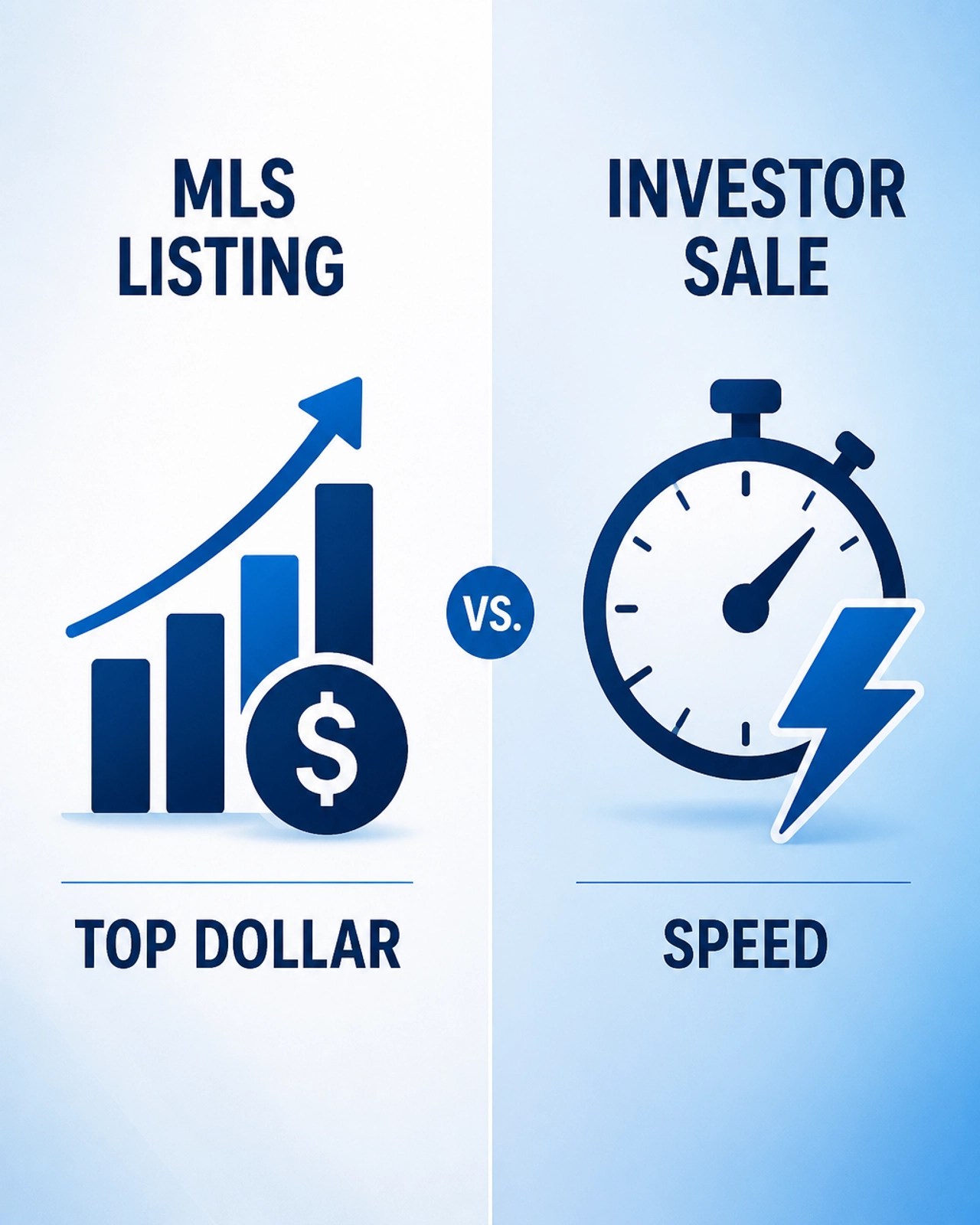
    Infographic comparing MLS Listing (Price) vs. Investor Sale (Speed)

    Option 2: Selling to an Investor (The "Speed & Certainty" Path)

    Selling to an investor (often called a "cash offer" or "off-market" sale) is a completely different animal. You aren’t looking for a family to move in; you’re looking for a professional buyer who wants the asset.

    The Pros:

    1. Speed: Investors don’t need 30 days for a mortgage. Many can close in as little as 7 to 14 days. If you’re relocating for a job or have a deadline, this is a huge win.
    2. "As-Is" Condition: This is the heavy hitter for many Maryland homeowners. If the roof is old, the carpet is stained, or the kitchen is from 1982, an investor doesn’t care. You don’t have to pick up a paintbrush or a hammer.
    3. Certainty: Cash offers usually come with fewer contingencies. There’s no appraisal to worry about and no bank that could deny the loan at the last minute.

    The Cons:

    1. The Convenience Fee: You are essentially trading equity for convenience. Because the investor is taking on the risk of repairs and the cost of holding the property, their offer will be lower than what you’d get on the open market.
    2. No Competition: Without the MLS, you only have one buyer. You lose the leverage of having five other people wanting the house.

    Side-by-Side: Which Fits Your Life?

    Feature Listing on the MLS Selling to an Investor
    Final Sale Price Higher (Market Value) Lower (Discounted)
    Closing Time 60 – 90 Days 7 – 14 Days
    Repairs Needed Often required for top dollar None (Sold "As-Is")
    Commission/Fees Traditional commissions apply Usually no commissions
    Privacy Public (Photos & Price online) Private (Off-market)

    A peaceful Maryland neighborhood street representing the local market context.

    The "Maryland Factor": Local Considerations

    In Maryland, our geography matters. If you have a townhome in a high-demand area like Columbia or a single-family home in Millersville, listing on the MLS might net you a much higher return because the buyer demand in those "sweet spots" is incredibly high.

    On the other hand, if you’re dealing with a vacant property, an inherited home that needs a total gut-job, or an absentee-owner situation where you just can’t manage the upkeep from afar, the investor route can be a lifesaver. It stops the "bleeding" of taxes, insurance, and maintenance costs immediately.

    Making the Smart Move

    The decision shouldn't be based on a "gut feeling." It should be based on a net-sheet comparison.

    Think of it this way:

    • Step A: What would the house sell for on the MLS? (Subtract commissions, closing costs, and the cost of repairs you’d need to do).
    • Step B: What is the investor offering "as-is"?

    The difference between those two numbers is the "Convenience Cost." For some, that cost is $30,000 and it’s not worth it. For others, that cost is $10,000, and avoiding three months of stress and $15,000 in repairs makes the investor offer the smarter choice.

    A professional reviewing real estate documents, providing clarity to the reader.

    We’re Here to Help You Sort the Details

    At K-Stone Enterprises, we believe in giving you the information first. Whether you want to explore listing your home for maximum exposure or you want to see what an "as-is" transition looks like, we can help you review the data for your specific Maryland property.

    You deserve to move with clarity, knowing you chose the path that fits your timeline and your wallet.

    Want this kind of insight every week? Join the Inner Circle — it's free and it keeps you ahead of the curve in the MD market.

    Send me the property address or basic details and I’ll let you know what information would be needed for the next step.


    Sonny, here is a tweet draft for the post:
    "Selling your Maryland home in 2026? 🏠 Should you list on the MLS for top dollar or sell to an investor for speed? We’re breaking down the pros, cons, and the 'convenience fee' so you can move with clarity. Read more on the blog! #MarylandRealEstate #HomeSellingTips #KStoneEnterprises"

    🧵 Check out Twisted Emotions (Threaded Creations KLM) on Etsy — unique, handcrafted apparel that lets you wear your story. Browse the shop here: https://threadedcreationsklm.etsy.com

  • Looking For a Home in Maryland? 10 Things to Know About the 2026 Market

    Looking For a Home in Maryland? 10 Things to Know About the 2026 Market

    If you’ve been watching the Maryland real estate market lately, you know it feels a bit different than the wild ride of the last few years. We’ve moved past the "bidding war for everything" era, but we haven't exactly hit a buyer's paradise either.

    📬 Join the Inner Circle — Get weekly Maryland market updates straight to your inbox. Most buyers don't know what's coming. You will. Subscribe now and get the unfair advantage.

    As of June 2026, the Maryland housing market is entering what many experts call a phase of "stabilization." It’s a market where patience and data-driven decisions are finally starting to pay off for buyers who know where to look. Whether you’re eyeing a townhouse in the Baltimore suburbs, a single-family home in Montgomery County, or something with a little more space on the Eastern Shore, the rules of the game have shifted.

    If you’re planning to jump into the market this summer or fall, here are 10 things you absolutely need to know about the Maryland real estate landscape in 2026.


    1. The Inventory Reality: Better, But Still Tight

    For years, the biggest hurdle for Maryland buyers was simply finding a house to look at. In June 2026, the inventory situation has improved, but it’s still technically a "seller's market."

    Recent data shows that Maryland has roughly 3 months of housing supply. While that’s an increase from the ultra-low levels we saw in 2022 and 2023, it’s still below the 4-6 months of supply that economists consider a "balanced" market. You won’t be fighting 30 other people for every single listing, but the good ones: the turnkey homes in top-tier school districts: still move fast.

    2. Price Appreciation Has Found a Steady Rhythm

    Conceptual image of a house balanced on a scale representing market stability

    The days of 10% or 15% year-over-year price spikes seem to be in the rearview mirror. Currently, the median home price in Maryland is holding steady around $448,000, which is about a 2.4% increase from this time last year.

    This is actually great news for buyers. It means you aren't chasing a moving target that’s out-appreciating your ability to save. Wealth is still being built through real estate, but it’s happening at a sustainable, predictable pace.

    3. Interest Rates: The 6% "New Normal"

    Interest rates have settled into a range that many are calling the new normal. For a 30-year fixed mortgage in Maryland, most well-qualified buyers are seeing rates between 6.0% and 6.5%.

    While we’d all love to see 3% again, those rates were a historical anomaly. The current 6% range is much closer to the long-term historical average. The key for 2026 buyers isn't waiting for a "crash" in rates: which most forecasters don't expect: but rather finding a monthly payment that fits comfortably within your budget today.

    4. Buying for the Monthly Payment, Not the Max Approval

    One of the biggest mistakes I see buyers making right now is looking at their "maximum approval" amount from a lender and assuming that’s their budget. In a 6% rate environment, your purchasing power is tied directly to your monthly cash flow.

    Smart Maryland buyers in 2026 are working backward. They decide what they want their monthly out-of-pocket (including taxes and insurance) to be, and then they find the price point that matches. This keeps you from being "house poor" and ensures you can actually enjoy living in your new home.

    5. The "14-Day Rule" for Negotiation Leverage

    A silver house key next to a Maryland map and keychain

    In 2021, if a house was on the market for 5 days, people thought something was wrong with it. In 2026, the pace has normalized.

    We are seeing a trend where homes that don't sell within the first 14 days often become prime targets for negotiation. If a property has been sitting for two weeks or more, sellers are much more open to:

    • Closing cost credits.
    • Rate buy-downs (where the seller pays to lower your interest rate).
    • Home inspection repairs.

    If you’re looking for a deal, don't just look at the "New Listings": look at the ones that have been active for a couple of weeks.

    6. Location Flexibility is the Secret Weapon

    With hybrid work remaining a staple for many Maryland professionals, the "commuter zones" have expanded. You might find significantly more value by looking 15-20 minutes further out from the major hubs like D.C. or Baltimore.

    Areas that were once considered "too far" now offer more square footage and larger lots for the same price point. When you expand your search radius even slightly, your options in the Maryland market often double. You can check out some of the current opportunities and neighborhood insights over at Millis Property.

    7. Maryland-Specific First-Time Buyer Programs

    If you are a first-time buyer, Maryland is one of the best states to be in. There are several state and county-level programs designed to help with down payments and closing costs.

    Programs like the Maryland Mortgage Program (MMP) often provide competitive rates and down payment assistance (DPA) that can make the difference between sitting on the sidelines and getting the keys to your first home. It’s always worth asking your lender specifically about "Maryland-specific" grants or low-interest second loans.

    8. The "Refi Later" Strategy

    Aerial view of a peaceful Maryland residential neighborhood

    You’ve probably heard the phrase, "Marry the house, date the rate." In 2026, this is a very real strategy. While mainstream forecasts suggest rates will stay in the 6s for the foreseeable future, there is always the possibility of a dip later in the decade.

    By buying now, you lock in the home price before further appreciation. If rates drop to 5.5% or lower in a year or two, you can explore refinancing. However, you should only buy if the current numbers work for you today: never count on a "guaranteed" refi down the road.

    9. Why "Timing the Market" Usually Fails

    I talk to people every week who say, "I’m waiting for the market to crash." Here’s the reality: with inventory still tight and demand remaining steady from a growing population, a "crash" isn't supported by the data.

    If you wait for a 1% drop in interest rates, you might find that home prices have appreciated 3% or 4% in that same timeframe. Often, the cost of waiting is higher than the benefit of a slightly lower rate. The best time to buy is when you are financially ready and find a property that meets your needs.

    10. The Importance of Local Expertise

    A professional workspace with a tablet showing property listings and a notepad

    Real estate is hyper-local. What’s happening in Annapolis might be completely different than what’s happening in Frederick. Working with someone who understands the nuances of Maryland contracts, local contingencies, and neighborhood-specific trends is your greatest advantage.

    As a licensed Maryland real estate professional with The Real Brokerage LLC, I focus on helping buyers navigate these complexities without the pressure. My goal is to provide the education and data you need to make a confident decision for your family or your investment portfolio. You can learn more about my background and how we work with clients at Lamont Milbourne – Real Brokerage.


    Final Thoughts

    The 2026 Maryland market requires a strategic approach. It’s not about rushing; it’s about being prepared. If you have your pre-approval ready, a clear understanding of your monthly budget, and a willingness to look at properties that might have been overlooked by the "day one" crowd, you are in a great position to succeed.

    Want this kind of insight every week? Join the Inner Circle — it's free and it keeps you ahead of the curve in the MD market.

    Send me the property address or basic details and I’ll let you know what information would be needed for the next step.


    Tweet Draft:
    Thinking about buying in Maryland this year? 🦀 The 2026 market is stabilizing, but you need a plan. From the "14-day rule" to the new 6% rate normal, here are 10 things you need to know before you start your search. #MarylandRealEstate #HomeBuyingTips #MDHousingMarket


    🧵 Check out Twisted Emotions (Threaded Creations KLM) on Etsy — unique, handcrafted apparel that lets you wear your story. Browse the shop here: https://threadedcreationsklm.etsy.com

  • How to Create Your Financial Clarity Plan in 5 Minutes

    How to Create Your Financial Clarity Plan in 5 Minutes

    Do you ever feel like you’re walking through a thick fog when it comes to your money? You know you’re working hard. You know the paycheck hits the account. But by the middle of the month, that "fog" sets in: you aren’t quite sure where it’s all going, why the debt isn't moving faster, or why the "experts" make it sound so complicated.

    Most people think a "financial plan" requires a leather briefcase, a three-hour meeting, and a mountain of spreadsheets.

    📬 Join the Inner Circle — Get weekly financial clarity insights straight to your inbox. Most people don't know what's coming. You will. Subscribe now and get the unfair advantage.

    Here’s a secret: Financial clarity doesn’t have to be complicated.

    In fact, you can map out a framework for clarity in about five minutes. It’s not about having all the answers right now; it’s about knowing which questions to ask and which experts to lean on. At K-Stone Enterprises, we believe in empowering you with information, not overwhelming you with jargon.

    Let’s break down your 5-minute financial clarity plan.

    The 5-Minute Clarity Framework

    Minute 1: The "Where Am I?" Snapshot

    Stop trying to track every penny for a second. Instead, look at the big picture. Most financial stress comes from the unknown.

    • Action: Write down two numbers. What came in last month? What absolutely had to go out (rent/mortgage, utilities, minimum payments)?
    • The Clarity: The gap between those two numbers is your "lifestyle and growth" fund. If that gap feels too small, we don’t just need to "spend less": we need to look at how to increase your cash flow.

    Minute 2: The "Leak" Check (Taxes & Bills)

    Did you know that many Americans are overpaying on their taxes and monthly bills without even realizing it? This is what we call "silent money leaks."

    • Action: Look at your last cell phone, internet, or cable bill. Then, think about your last tax return. Do you feel like you're leaving money on the table?
    • The Clarity: Most people pay the "sticker price" for life. Financial clarity means realizing those numbers aren't always set in stone.

    Minute 3: The "Speed" Check (Debt Strategy)

    Debt isn't just about the balance; it's about the time and interest.

    • Action: Pick your biggest debt. If you keep paying the minimum, how many years will it take to be free?
    • The Clarity: Clarity is realizing that a structured plan can often cut that time down significantly by focusing on interest cancellation rather than just "paying more."

    Minute 4: The "Foundation" Check (Credit)

    Your credit score is the "price tag" of your life. It determines your interest rates, your insurance premiums, and even your ability to leverage opportunities.

    • Action: When was the last time you looked at the details of your credit report, not just the score?
    • The Clarity: A high score isn't a trophy; it's a tool. Knowing how to maintain and improve it is a core pillar of wealth.

    Minute 5: The "Liaison" Step

    The final minute is the most important. You don't have to be a tax pro, a credit expert, or a debt negotiator yourself.

    • Action: Acknowledge that you can’t do it all alone.
    • The Clarity: Real clarity comes from having a team of experts handle the heavy lifting while you focus on your life and your family.

    An infographic showing the four pillars of financial health: Taxes, Debt, Credit, and Bill Negotiation.

    Deep Dive: The Four Pillars of Financial Clarity

    Now that you’ve done the 5-minute snapshot, let’s talk about the four areas where most people find their greatest breakthroughs. This is where Lamont Milbourne and K-Stone Enterprises act as your liaison to specialized resources and information.

    1. Tax Awareness: Keep More of What You Earn

    Most people focus solely on making more money. But if you make an extra $1,000 and the government takes $300, you’ve only "cleared" $700. Tax awareness is about shifting that ratio.
    Through the resources we share, people learn about strategies used by the wealthy: like maximizing home-based business deductions: to legally and ethically minimize their tax liability. It’s not about "beating the system"; it’s about using the rules the way they were intended.

    2. Bill Negotiation: The "Hidden" Cash Flow

    Why pay full price for your cell phone or internet if you don't have to? Many service providers have "retention" rates or unadvertised discounts. However, most people don't have the time or the desire to sit on hold for three hours to argue over a $20 discount.
    This is where professional negotiation services (like BillShredder) come in. They do the talking for you. If they save you money, you win. If they don't, you haven't lost anything. That's a simple, clear win for your monthly budget.

    3. Debt Elimination: Cutting the Chains

    Debt can feel like an anchor. But what if you could see exactly when you'll be debt-free? Financial education resources help people create a roadmap that prioritizes interest reduction. By restructuring how you pay your existing debts, it’s possible to shave years: sometimes decades: off a mortgage or student loan without necessarily increasing your monthly out-of-pocket costs.

    4. Credit Education: Building Your Foundation

    Your credit report is often full of errors or outdated information that drags your score down. Credit education isn't just about "fixing" a number; it's about understanding the laws that protect you as a consumer. When you have the right information, you can ensure your credit profile accurately reflects your financial responsibility, which opens doors to better rates and more opportunities.

    A person managing their finances via a smartphone, showing successful negotiation and organization.

    Why a Liaison Matters

    In the world of financial services, it’s easy to get lost. You’ll find people trying to sell you insurance, stocks, or "get rich quick" schemes.

    Lamont Milbourne and the team at K-Stone Enterprises take a different approach. We don't guarantee financial results or claim to have a "magic wand" for your debt. Instead, Lamont acts as a liaison.

    Think of a liaison as a bridge. On one side, you have your current financial situation. On the other side, there is a vault of experts: IRS-enrolled agents, credit professionals, and seasoned negotiators. Lamont’s job is to connect you to that vault of information and resources so you can make an informed decision for yourself.

    Financial clarity isn't about someone doing your life for you; it's about having the right tools to do it yourself, backed by people who know the terrain.

    Two professionals in a meeting, illustrating the role of a liaison and expert partnership.

    The Next Step Toward Your Clarity

    You've spent five minutes thinking about your plan. You’ve seen the four pillars. You understand that you don't have to navigate the fog alone.

    So, what’s next?

    The fog doesn't clear because the wind blows; it clears because you turn on the lights. By reviewing the information available through our partnership with MWR Financial, you can see exactly how these experts work and whether their membership-based resources are the right fit for your goals.

    No pressure. No hype. Just information.

    📬 Join the Inner Circle — Want this kind of insight every week? Join the Inner Circle — it's free and it keeps you ahead of the curve.

    Review the information here when ready: www.mwrfinancial.com/krnrstn21

    Want me to send you the information so you can review how it works?

    Reply INFO and I’ll send the next step.


    Note to Sonny: Tweet draft ready for the "Financial Clarity" post.
    Tweet Draft: "Financial fog is real, but it doesn't have to be your permanent state. 🌫️ Check out our latest guide on creating a Financial Clarity Plan in just 5 minutes. No spreadsheets required. Just focus. #FinancialClarity #KStoneEnterprises #WealthBuilding"

    Internal Note for Lamont: This post focuses on the MWR Financial Edge pillars (Taxes, Bills, Debt, Credit). It frames you as a liaison to these expert resources and makes no specific guarantees on scores or savings. All CTAs are compliant with our primary goals.

    🧵 Check out Twisted Emotions (Threaded Creations KLM) on Etsy — unique, handcrafted apparel that lets you wear your story. Browse the shop here: https://threadedcreationsklm.etsy.com

  • Top 10 Maryland Real Estate Investing Ideas for 2026

    Top 10 Maryland Real Estate Investing Ideas for 2026

    If you’ve been watching the Maryland real estate market lately, you know it’s a unique beast. As we move through 2026, the landscape has shifted from the "wild west" of the early 2020s into a more disciplined, data-driven environment. Interest rates are hovering in the mid-6% to low-7% range, inventory remains historically tight, and the median sale price across the state is sitting between $415,000 and $455,000.

    📬 Join the Inner Circle — Get weekly Maryland real estate insights straight to your inbox. Most investors don't know what's coming. You will. Subscribe now and get the unfair advantage.

    For investors, this means the days of "buying anything and watching it go up" are over. Today, the winners are the ones who know exactly where to look and how to underwrite for the current climate. Whether you’re a seasoned pro or just getting your feet wet in the Old Line State, here are the top 10 Maryland real estate investing ideas for 2026.

    1. The Millersville Momentum Play

    If there’s one place that has set the state on fire recently, it’s Millersville. With sale prices jumping nearly 60.9% year-over-year in recent data, this submarket is a magnet for appreciation-focused investors. Why? It’s the perfect storm of top-tier schools, proximity to major job hubs in Annapolis and Baltimore, and a limited supply of high-quality inventory. In 2026, the play here is identifying properties that need a cosmetic refresh to match the high standards of the local buyer pool.

    2. Baltimore City Rowhouse Revitalization

    While the suburbs are booming, Baltimore City offers a different kind of opportunity: cash flow. Neighborhoods like Canton, Frankford, and Riverside are seeing a resurgence. With the city’s median price around $240,000, well below the state average: investors can find better rent-to-price ratios here than almost anywhere else.

    A row of beautifully renovated historic Baltimore rowhouses at dusk, representing urban revitalization.

    The 2026 strategy in Charm City is all about "workforce housing": buying structurally sound units and upgrading the finishes to attract the growing population of young professionals who want to be near the inner harbor but can't afford a suburban mortgage yet.

    3. Transit-Oriented Development (TOD) in Montgomery County

    Montgomery County remains one of the most stable high-income markets in the country. In 2026, the focus is on Gaithersburg and areas surrounding the Metro extensions. As more people return to physical offices or hybrid schedules, living within walking distance of transit is no longer a luxury: it’s a requirement. Look for small multi-family units or condos near transit hubs where the rental demand is essentially "baked in."

    4. The Crofton Connection

    Crofton has seen a staggering 38.1% growth in sale prices, making it a "sister market" to Millersville in terms of demand. The local inventory is extremely thin: often less than 3 months of supply: which means any property priced correctly and presented well will move. For investors, this is an ideal spot for a "buy and hold" strategy, banking on the long-term stability of the Anne Arundel County market.

    5. Value-Add Rentals in Reisterstown & Pikesville

    These older, inner-ring suburbs are often overlooked for the "shiny" new developments further out, but they are goldmines for rental investors. Reisterstown recently saw a 25.5% jump in prices. The strategy here is simple: find the "worst house on a good block." In a market where new construction is lagging, a well-rehabilitated 1970s split-level or rancher can command top-tier rents from families who need the space but are priced out of buying.

    6. Sustainable and "Green" Retrofitting

    In 2026, Maryland’s energy standards and buyer preferences are leaning heavily toward sustainability. Investors who take existing properties and install heat pumps, solar arrays, or energy-efficient insulation are finding two things: lower carrying costs and higher resale values. This isn't just about being "green"; it's about future-proofing your portfolio against rising utility costs.

    7. The California, MD Growth Spurt

    Don't let the name fool you: this is St. Mary’s County. California, MD has popped up on the radar with 25.0% price growth. Driven by the defense industry and the Patuxent River Naval Air Station, this is a niche market with a very specific, high-income tenant base. It’s a great area for medium-term rentals (3-6 months) catering to contractors and military personnel on assignment.

    8. ADU Additions (Accessory Dwelling Units)

    Maryland has become more progressive regarding zoning for ADUs in several counties. If you own a property with a large lot in a high-demand area like Silver Spring or Bethesda, adding a "granny flat" or basement apartment can effectively double your rental income without the cost of a second land purchase. This is one of the most efficient ways to manufacture "density" in a tight inventory market.

    A stylized architectural rendering of a modern backyard ADU (Accessory Dwelling Unit) in a Maryland suburban setting.

    9. Small Multi-Family in "B-Class" Suburbs

    While everyone is chasing single-family homes, the small multi-family market (duplexes and triplexes) in areas like Bel Air South or Severn offers a path to better cash flow. With median rents statewide around $2,250, these units allow you to spread your vacancy risk across multiple tenants while staying in high-demand school districts.

    10. The "Deal Review" Strategy

    Perhaps the smartest investment idea for 2026 isn't a location, but a process. Because rates are higher and margins are tighter, the "back of the napkin" math won't cut it anymore. Successful investors are now using sophisticated deal analysis, accurate ARV (After Repair Value) comps, and detailed rehab budgets before they ever make an offer.

    At Cornerstone, this is where we thrive. We help investors navigate the Maryland landscape by providing the professional context needed to make informed decisions. Whether you’re looking at a vacant property in Baltimore or a high-growth flip in Severna Park, having a licensed professional in your corner is the difference between a profitable exit and a costly mistake.

    Making the Numbers Work in 2026

    Success this year requires a shift in mindset. You have to underwrite for today’s rates (6-7%) and treat any future refinancing as a "bonus," not a necessity. You need to focus on monthly payment affordability for your end-users, whether they are renters or buyers.

    Maryland is still a seller-leaning market, but buyers are more selective than they used to be. Professional staging, high-quality photography, and realistic pricing are mandatory. The market is rewarding discipline, and there is plenty of room for those who are willing to do the work.

    Your Next Step

    Do you have a lead on a property? Are you looking at a potential deal but aren't sure about the neighborhood trends or what the next step should be?

    Lamont Milbourne and the team at K-Stone Enterprises are here to help you qualify opportunities and move through the process with confidence. We focus on the Maryland market and help you separate the hype from the actual opportunities.

    Want this kind of insight every week? Join the Inner Circle — it's free and it keeps you ahead of the curve in the MD market.

    Send me the property address or basic details and I’ll let you know what information would be needed for the next step.


    Tweet for Sonny:
    "Maryland Real Estate is evolving! 🦀 From the 60% growth in Millersville to the rental gems in Baltimore, see where the smart money is moving in 2026. Check out our Top 10 Investing Ideas list now! #MarylandRealEstate #RealEstateInvesting #KStoneEnterprises"

    Note for Lamont:
    Lamont, this post uses the most recent 2026 market data from Maryland REALTORS and Redfin. It focuses strictly on the Real Estate lane, providing educational value for investors without making specific financial guarantees or offer claims. All links lead to your professional real estate pages.

    🧵 Check out Twisted Emotions (Threaded Creations KLM) on Etsy — unique, handcrafted apparel that lets you wear your story. Browse the shop here: https://threadedcreationsklm.etsy.com
  • Credit Education Secrets: What the Experts Aren’t Telling You

    Credit Education Secrets: What the Experts Aren’t Telling You

    If you’ve ever felt like your credit score is a random number generated by a mysterious machine in a dark basement, you aren't alone. In the world of finance, credit is often treated like a "dark art" that only the "experts" can understand.

    But here’s the thing: Credit isn’t a secret. It’s a math problem.

    📬 Join the Inner Circle — Get weekly credit and financial clarity insights straight to your inbox. Most people don't know what's coming. You will. Subscribe now and get the unfair advantage.

    The reason it feels like a secret is that most people are looking in the wrong places for answers. You might be listening to "gurus" who promise overnight fixes or apps that give you a "score" but no real education on how that score is calculated.

    At K-Stone Enterprises, we believe in financial education and clarity. I’m Lamont Milbourne, and while I’m not a credit repair specialist or a financial advisor, I am a liaison to the resources and information that can help you see the full picture.

    In this deep dive, we’re going to pull back the curtain on the "secrets" the experts aren't telling you: so you can stop guessing and start understanding.

    Secret #1: Your "Score" is the Least Important Part of the Equation

    Most people obsess over the three-digit number. They check it daily, celebrate a 5-point jump, and panic over a 2-point drop.

    The Truth: Your score is just a summary. The real power lies in your Credit Report.

    Lenders don't just look at a number; they look at the behavior behind the number. You could have a 720 score, but if you have a recent late payment or high credit utilization, a lender might still see you as a risk. Conversely, someone with a 680 and a perfectly clean five-year payment history might be more attractive to certain banks.

    Education starts with understanding your report. When was the last time you actually read the 30+ pages of your full credit file? Most people haven't. They look at the dashboard of an app and think they’ve done their homework. Real financial clarity comes from knowing exactly what the bureaus are saying about you.

    A person sitting at a desk feeling empowered after reviewing their financial plan and credit report.

    Secret #2: "Debt-Free" Does Not Equal "Credit-Healthy"

    There is a massive misconception that the best way to have great credit is to have zero debt. While being debt-free is a fantastic personal goal, the credit system is designed to measure how you manage debt, not how you avoid it.

    If you have no active credit lines, no credit cards, and no loans, your score will eventually "thin out" and disappear. The "secret" here is strategic usage.

    Experts won't always tell you this because it sounds counterintuitive: You often need to carry a small, manageable balance (usually under 10% of your limit) and pay it off on time to show the system you are an active, responsible borrower. Using a credit card for a small monthly subscription and setting it to autopay is one of the most effective ways to build a positive history without ever paying a dime in interest.

    Secret #3: The "Soft Pull" Myth is Costing You Clarity

    I hear it all the time: "I don't want to check my credit because it will lower my score."

    Let's clear this up right now. Checking your own credit is a "soft inquiry." It has zero impact on your score.

    The experts benefit when you are afraid to look at your own numbers because it keeps you dependent on them for updates. In 2026, with the rise of identity theft and data breaches, not checking your credit regularly is a massive risk. You should be auditing your report at least quarterly to ensure there are no errors, unauthorized accounts, or outdated information dragging you down.

    Secret #4: Timing is Everything (The Utilization Trap)

    You might pay your credit card off in full every single month and still see your score drop. Why? Timing.

    Credit card companies report your balance to the bureaus once a month, usually on your "statement closing date": not your "due date."

    If your statement closes on the 15th with a $2,000 balance, and you pay it off on the 20th, the credit bureaus see a $2,000 balance. If your limit is $3,000, it looks like you are using 66% of your credit, even if you paid it to zero five days later.

    The secret? Find out your statement closing date and pay the bill before that date. This ensures the bureau sees a low utilization rate, which accounts for roughly 30% of your total score calculation.

    Motivational finance prompt asking users to rate the importance of keeping more of their paycheck and eliminating debt.

    Secret #5: There Are No "Quick Fixes," Only Consistent Habits

    The internet is full of "credit repair" companies promising to "delete" bad marks in 30 days. Be very careful here. While there are legal ways to dispute inaccurate information, there is no "magic button" to remove legitimate, accurate negative history.

    The real "secret" is that credit education is about shifting your habits.

    • 35% of your score is Payment History: This is the heavyweight champion. One missed payment can hurt more than ten on-time payments help.
    • 15% is Length of History: Closing an old card "to be clean" actually hurts you by shortening your average account age.
    • 10% is Credit Mix: Having a mix of revolving credit (cards) and installment loans (auto, mortgage) shows you can handle different types of debt.

    Instead of looking for a repair, look for education. Understand how the system works so you can make it work for you.

    Why Financial Education Matters in 2026

    We are living in an era where financial literacy is more important than ever. Whether you are looking to buy a home in Maryland or simply want to protect your family’s financial future, understanding the mechanics of money is the first step.

    At K-Stone Enterprises, we point people toward resources that provide:

    1. Debt Education: Understanding how to strategically move toward zero.
    2. Tax Awareness: Learning how to keep more of what you earn.
    3. Credit Clarity: Seeing the report for what it is and learning the rules of the game.

    I don’t make guarantees about scores or results. What I do provide is a bridge to the information you need to make better decisions. When you have the right information, you don't need "secrets": you have a strategy.

    Promotional graphic for the S.I.M.P.L.E Leverage Everything weekly event focusing on wealth multiplication and protection.

    Your Next Steps

    If you're tired of guessing and you're ready to actually review the information that could change your perspective on credit and debt, I've got a place for you to start.

    The MWR Financial membership is designed to provide the education and resources that most "experts" keep behind a paywall. It’s about empowering you to take control of your own financial narrative.

    Want me to send you the information so you can review how it works?

    Or, if you’re ready to dive in and see the details for yourself:

    Want this kind of insight every week? Join the Inner Circle — it's free and it keeps you ahead of the curve.

    📬 Join the Inner Circle — Get weekly credit and financial clarity insights straight to your inbox. Most people don't know what's coming. You will. Subscribe now and get the unfair advantage.

    Review the information here when ready: www.mwrfinancial.com/krnrstn21


    🧵 Check out Twisted Emotions (Threaded Creations KLM) on Etsy — unique, handcrafted apparel that lets you wear your story. Browse the shop here: https://threadedcreationsklm.etsy.com

    Note for Sonny:
    Here is the tweet draft for this post:
    "Stop letting 'credit secrets' keep you in the dark. 🌑 Credit isn't a mystery; it's a math problem. 📊 We’re breaking down the myths and showing you how to get real financial clarity in 2026. Check the latest from K-Stone Enterprises! #CreditEducation #FinancialClarity #KStone"


  • 7 Mistakes You’re Making with Your Maryland Home Sale (and How to Fix Them)

    7 Mistakes You’re Making with Your Maryland Home Sale (and How to Fix Them)

    Selling a home in Maryland isn’t what it used to be. If you’re still thinking about the “glory days” of 2021 when you could stick a sign in the yard and have thirty offers by lunchtime, I’ve got some news for you: the 2026 market has a different rhythm.

    Today’s buyers in Anne Arundel County, Prince George’s County, and across Maryland are more calculated. They’re dealing with different affordability levels, and they’re looking for value. That doesn't mean you can't get a great price for your home, it just means you can't afford to make the same mistakes that used to get "swept under the rug" when inventory was non-existent.

    📬 Join the Inner Circle — Get weekly Maryland market updates straight to your inbox. Most buyers and sellers don't know what's coming. You will. Subscribe now and get the unfair advantage.

    If you’re planning to put your Maryland property on the market, you want a smooth transaction that gets you to the closing table without the headache. To help you get there, let’s look at the seven most common mistakes Maryland sellers are making right now and, more importantly, how you can fix them.


    🧵 Check out Twisted Emotions (Threaded Creations KLM) on Etsy — unique, handcrafted apparel that lets you wear your story. Browse the shop here: https://threadedcreationsklm.etsy.com

    1. Pricing Based on "Testing the Market" (Instead of Data)

    This is the #1 mistake I see. Many sellers want to start high just to "see what happens," thinking they can always lower the price later. In 2026, that strategy is backfiring.

    Data shows that about 23% of Maryland homes that sell today only do so after a price reduction. The problem? When a home sits on the market for 30, 60, or 90 days, it develops a "stale" reputation. Buyers start asking, "What's wrong with it?"

    The Fix: Work with a professional to look at the current 2026 comparables, not what your neighbor's house sold for eighteen months ago. Pricing slightly at or even just a hair below market value often creates a competitive environment that drives the price up naturally, rather than starting high and chasing the market down.

    A real estate professional showing a homeowner current Maryland market data trends on a screen.

    2. Neglecting Curb Appeal (The 7-Second Rule)

    You’ve heard it before, but it’s worth repeating: you never get a second chance to make a first impression. In Maryland, where we have beautiful seasonal changes, curb appeal is everything.

    In the time it takes a buyer to walk from their car to your front door, usually about seven seconds, they’ve already formed an opinion about how well the home has been maintained. If the bushes are overgrown, the paint is peeling, or the walkway is cracked, they’re already calculating "repair costs" in their head before they even see your beautiful kitchen.

    The Fix: Spend a weekend on the basics. Power wash the siding, trim the hedges, and put a fresh coat of paint on the front door. These small, low-cost moves can significantly impact a buyer's perceived value of the home.

    A close-up of a well-maintained Maryland home entrance with a fresh front door and manicured landscaping.

    3. Ignoring Small "Nuisance" Repairs

    It’s easy to live with a leaky faucet or a door that doesn't quite latch for years. But to a buyer, these are red flags. In the 2026 Maryland market, buyers are often looking for "move-in ready."

    One specific thing to watch out for in our region? Moisture. Maryland’s humidity can lead to issues in crawl spaces or attics that might not bother you daily but will absolutely derail a home inspection.

    The Fix: Conduct a "pre-inspection" walk-through. Fix the leaky faucets, replace the burnt-out lightbulbs, and make sure your HVAC filters are clean. Addressing these small things now prevents them from becoming a mountain of "concessions" during negotiations.

    4. Failing to Disclose Known Defects (The Legal Trap)

    Maryland law is very specific about the Residential Property Disclosure and Disclaimer Statement. You have a legal obligation to either disclose known defects or disclaim them.

    Trying to hide a basement that seeps during heavy rain or a roof leak that you "patched up" isn't just unethical, it's a massive legal liability. If a buyer discovers a latent defect after closing that you knew about and didn't disclose, you could find yourself in a very expensive legal battle.

    The Fix: Be honest. Disclosing a past issue that has been repaired actually builds trust with a buyer. It shows you’ve been a responsible homeowner.

    A desk featuring the official Maryland Property Disclosure forms, emphasizing the importance of legal honesty.

    5. Being Inflexible with Showings

    I get it, having strangers walk through your house while you're trying to live your life is a pain. But every time you decline a showing or require 24-hour notice, you are shrinking your pool of potential buyers.

    In a market where buyers have more options, they often won't wait for your schedule. If they can't see your house today, they'll just go see the one three blocks over that is available.

    The Fix: Try to be as flexible as possible during the first two weeks of the listing. Keep the house "show-ready" and have a plan for where the family (and the pets!) can go on short notice. The more eyes you get on the property, the faster it sells.

    6. Underestimating Maryland Closing Costs

    One of the biggest shocks for sellers comes when they see the "Net Sheet" at the end of the deal. Maryland has specific taxes that catch people off guard.

    Between the 0.5% state transfer tax, local recordation taxes (which vary by county but can be significant), and the standard commissions, your total closing costs can easily hit 8–10% of the sale price. If you haven't budgeted for this, your "profit" might look a lot smaller than you expected.

    The Fix: Ask for a "Seller’s Net Sheet" before you even list the property. This document breaks down exactly what you’ll walk away with after all taxes, fees, and commissions are paid. Knowing your numbers from day one prevents "closing table sticker shock."

    7. Letting Emotions Drive the Negotiation

    Your home is where your memories are. It’s where your kids grew up or where you started your business. Because of that, it’s very easy to take a low offer or a tough inspection report personally.

    But here’s the reality: to the buyer, this is a business transaction. If you get defensive or angry during negotiations, you might kill a deal over a $500 repair credit that, in the grand scheme of a $500,000 sale, doesn't really matter.

    The Fix: Treat the sale like a business deal. Stay focused on the goal: getting the property sold so you can move on to your next chapter. Having a professional liaison helps keep the emotions out of the room so you can make logical, data-driven decisions.

    A happy homeowner handing over keys to a buyer in front of a Maryland house with a 'SOLD' sign.

    The Bottom Line

    Selling a home in Maryland doesn't have to be a stressful ordeal. By avoiding these common pitfalls, pricing correctly, focusing on first impressions, being honest in your disclosures, and understanding your costs, you set yourself up for a win.

    If you're wondering what the 2026 market looks like for your specific neighborhood or what steps you should take before putting a sign in your yard, let’s talk. My goal is to make sure you have the clarity and education you need to make the best move for your family.

    Want this kind of insight every week? Join the Inner Circle — it's free and it keeps you ahead of the curve in the MD market.

    📬 Join the Inner Circle — Get weekly Maryland market updates straight to your inbox. Most buyers and sellers don't know what's coming. You will. Subscribe now and get the unfair advantage.

    Send me the property address or basic details and I’ll let you know what information would be needed for the next step.


    Note to Sonny:
    Hey Sonny! Just finished a deep dive for the Maryland homeowners. Here is the tweet for the feed:

    "Thinking of selling your Maryland home in 2026? 🏠 Don't let these 7 common mistakes cost you thousands. From pricing traps to disclosure 'don'ts,' we're breaking down how to win in the current market. Check out the latest on the blog! #MarylandReal Estate #HomeSellingTips #Cornerstone"


  • 7 Mistakes You’re Making with Asset Protection Awareness (and How to Fix Them)

    7 Mistakes You’re Making with Asset Protection Awareness (and How to Fix Them)

    If you’ve ever felt like your hard-earned assets are a bit like a sandcastle at high tide: waiting for the next big wave to wash them away: you aren’t alone. In 2026, the financial landscape is more complex than ever. Between the rise of digital assets, shifting economic trends, and an increasingly litigious society, understanding how to protect what you’ve built isn't just for the ultra-wealthy. It’s for anyone who values their peace of mind.

    📬 Join the Inner Circle — Get weekly financial clarity insights straight to your inbox. Most people don't know what's coming. You will. Subscribe now and get the unfair advantage.

    At K-Stone Enterprises, we see asset protection awareness as a core pillar of financial education. Lamont Milbourne and our team aren't here to give you legal or tax advice: we aren’t attorneys or CPAs. What we are is your liaison to the information and resources that help you make better, more informed decisions for your family’s future.

    Let’s dive into the seven most common mistakes people make regarding asset protection awareness and, more importantly, how you can start fixing them today.

    1. The "I’m Not Rich Enough" Myth

    One of the biggest hurdles in financial education is the belief that asset protection is a "rich person's game." Many people assume that if they don't have a multi-million dollar portfolio, they aren't at risk.

    The reality in 2026 is that anyone with a home, a savings account, or even a modest small business is a potential target for creditors, lawsuits, or unforeseen financial shocks. If you have something to lose, you have something to protect. Asset protection awareness starts with acknowledging the value of what you currently have: no matter the size.

    A promotional graphic advertising the weekly 'S.I.M.P.L.E Leverage Everything!' online event.

    How to fix it: Shift your mindset. Start viewing asset protection as a defensive strategy for your current lifestyle, not just a luxury for the 1%. Education is the first step toward building that shield.

    2. The "Too Little, Too Late" Trap

    Waiting until you see a "Notice of Pending Action" or a lawsuit in your mailbox to start thinking about protection is like trying to buy fire insurance while your kitchen is already in flames. By then, it’s often too late.

    In the world of financial awareness, this is known as a "fraudulent transfer" risk. If you move assets around after a threat appears, a court can often reverse those moves. True protection is proactive, not reactive. It needs to be part of your foundational financial structure long before a storm hits.

    How to fix it: Make asset protection a part of your regular financial check-ups. Whether you’re reviewing your credit education or debt awareness, always ask: "Is my foundation secure if something goes wrong tomorrow?"

    3. The Danger of Commingling

    This one is specifically for the entrepreneurs and side-hustlers out there. "Commingling" is a fancy way of saying you’re mixing your personal and business money. If you’re using your business credit card for a grocery run or paying your business bills out of your personal checking account, you’re poking holes in your own protection.

    When you mix funds, you risk "piercing the corporate veil." If a legal issue arises with your business, a creditor might argue that the business and you are essentially the same entity, putting your personal house and savings at risk.

    A professional individual in a modern home office reviewing organized financial folders and a laptop.

    How to fix it: Maintain strict separation. Separate bank accounts, separate credit lines, and meticulous record-keeping are non-negotiable. It might feel like extra paperwork now, but it's the armor that protects your personal life from business risks.

    4. Over-Reliance on a Single Shield (Insurance)

    Don't get us wrong: insurance is vital. But relying only on a standard liability policy is a major mistake. Many people assume their insurance will cover every possible scenario, only to find out during a crisis that there are exclusions, caps, or deductibles they didn't account for.

    In 2026, we’ve seen that insurance is just one piece of the puzzle. An integrated strategy involves looking at how your assets are titled, the entities you use (like LLCs), and how you manage your overall debt and credit.

    Blue background featuring floating money and a motivational prompt encouraging viewers to rate the importance of keeping more of their paycheck.

    How to fix it: Review your coverage annually, but don't stop there. Look into how memberships and educational resources like www.mwrfinancial.com/krnrstn21 can provide a more comprehensive view of your financial health, including bill negotiation awareness and tax awareness.

    5. Misunderstanding Privacy vs. Secrecy

    There’s a common misconception that asset protection is about "hiding money." In the modern age, "hiding" things is nearly impossible and often illegal. Effective asset protection is about privacy and structure, not secrecy.

    Privacy means making it harder for a casual observer to see exactly what you own and how it’s connected. When your assets are held in well-structured entities or trusts, you aren't "hiding" from the law: you're simply following established rules to ensure your private business stays private.

    How to fix it: Focus on lawful structures. Educate yourself on how different entity types (like LLCs or trusts) work within your state’s regulations. The goal is to be transparent with the government but private from the public.

    6. Forgetting Digital Assets & New Technology

    It’s 2026. If your asset protection plan only includes your physical house and your bank account, you’re missing a huge piece of the pie. What about your cryptocurrency? Your digital business accounts? Your intellectual property?

    Digital assets are often the most vulnerable because they are easy to overlook in traditional estate and protection planning. Without a clear plan for who has access and how they are protected, these assets can vanish into the "digital void" or be easily compromised by bad actors.

    Conceptual image of digital asset protection with a metallic key resting on a smartphone and a holographic grid.

    How to fix it: Create a digital asset inventory. Document your accounts, keys, and recovery phrases in a secure, offline location. Ensure your awareness of cybersecurity is as high as your awareness of physical asset protection.

    7. The DIY Disaster

    We love the "Do It Yourself" spirit: it’s how many great businesses start. But when it comes to the technical structures of asset protection, trying to DIY based on a random internet template is a recipe for disaster.

    One wrong word in an operating agreement or a missed filing deadline can render your entire protection strategy useless. Lamont Milbourne and K-Stone Enterprises focus on providing you with the awareness and resources to understand the landscape, but we always advocate for using professional tools and experts when it's time to pull the trigger.

    How to fix it: Use educational resources to learn the "what" and "why," but don't skip the "who." Surround yourself with a team of professionals who specialize in these areas.

    Why Awareness is Your Best Asset

    Asset protection isn't a one-and-done task. It’s a continuous process of education and refinement. As your life changes: maybe you buy a new property in Maryland, start a new business venture, or your family grows: your protection needs will change too.

    At K-Stone Enterprises, we believe that a financially educated client is a protected client. By understanding these seven mistakes, you're already ahead of the curve. You’re moving from a place of uncertainty to a place of clarity and power.

    Remember, Lamont is here to act as your liaison. We provide the information and the pathway; you provide the vision for your future.

    Want this kind of insight every week? Join the Inner Circle — it's free and it keeps you ahead of the curve.

    Want me to send you the information so you can review how it works?

    Review the information here when ready: www.mwrfinancial.com/krnrstn21


    Tweet Draft for Sonny:

    "Think asset protection is only for the 1%? Think again. 🛡️ In 2026, your awareness is your best defense. We’re breaking down the 7 biggest mistakes people make with their financial security: and how to fix them. Read more: [Link] #FinancialEducation #KStoneEnterprises #AssetProtection"


    🧵 Check out Twisted Emotions (Threaded Creations KLM) on Etsy — unique, handcrafted apparel that lets you wear your story. Browse the shop here: https://threadedcreationsklm.etsy.com

  • Looking for Business Funding? 10 Things You Should Know About Modern Requirements

    Looking for Business Funding? 10 Things You Should Know About Modern Requirements

    Getting capital for your business in 2026 isn’t what it used to be. If you’re still walking into a local bank branch with a 50-page printed business plan and a handshake, you might be in for a surprise. The landscape has shifted. Traditional banks are becoming more selective, while fintech, embedded finance, and AI-driven underwriting are taking over the driver's seat.

    At K-Stone Enterprises, we see a lot of entrepreneurs who have the passion and the product, but they lack the "fundability" profile that modern lenders require. Lamont Milbourne acts as your liaison to the resources and information you need to bridge that gap. We don’t guarantee funding: no one should: but we do believe in the power of financial education to put you in the best possible position.

    Here are 10 things you need to know about the modern requirements for business funding in today’s market.

    1. The Shift from Banks to Fintech

    The most significant trend in 2026 is where the money is coming from. Traditional banks have become "slower and pickier," with over 76% of small businesses now bypassing them entirely. For deals under $250,000, non-bank and online lenders have become the primary source of capital. These lenders prioritize speed and digital data over traditional collateral. If you want funding fast, you need to look where the modern market is moving.

    2. Your "Fundability" Profile is Your New Business Card

    Lenders are looking at more than just your revenue. They are looking at your business's legitimacy. Do you have a professional business address (not a P.O. Box)? Is your business phone number listed in 411 directories? Is your email address professional, or is it still a generic @gmail account? In 2026, these small details are often the first "knock-out" criteria used by automated underwriting systems.

    A flat lay of professional business documentation for 2026, including a D-U-N-S registration and a business credit card.

    3. The Power of the D-U-N-S Number

    If you don’t have a D-U-N-S number, your business essentially doesn’t exist to the major credit bureaus. Issued by Dun & Bradstreet, this nine-digit ID is the foundation of your business credit profile. Without it, you can’t generate a PAYDEX score, which is the "FICO" of the business world. Registering for this is a critical first step in moving away from relying solely on your personal credit.

    4. Aim for a PAYDEX Score of 80+

    Your PAYDEX score (ranging from 0 to 100) is based entirely on how you pay your vendors. To be competitive for the best rates and terms in 2026, you should aim for a score of 80 or higher. Achieving this requires having at least three to five trade lines reporting to the bureaus and: this is the secret: paying those vendors 10 to 15 days early. In a digital-first world, "on time" is the bare minimum; "early" is what gets you the best funding.

    5. Personal Credit Still Matters (The "PG" Factor)

    Many entrepreneurs hope to get business funding with zero personal liability. While that’s the ultimate goal, most modern lenders still require a Personal Guarantee (PG) for newer businesses or smaller lines of credit. Your personal credit score acts as a safety net for the lender. Keeping your personal credit education a priority is just as important as building your business credit.

    MWR @Home Opportunity Promotion emphasizing financial freedom and multiple income streams.

    6. DSCR: The Magic Number is 1.25

    Lenders in 2026 are obsessed with your Debt Service Coverage Ratio (DSCR). This is a simple calculation: your operating income divided by your total debt payments. Most traditional and SBA-type lenders want to see a DSCR of 1.25 or higher. This means for every $1 you owe in debt, your business should be bringing in at least $1.25 in profit. If you’re below 1.0, you are technically unable to cover your obligations, and funding will be nearly impossible to secure.

    7. Clean Digital Records are Non-Negotiable

    Modern underwriting is increasingly driven by AI. Lenders will often ask to "connect" to your bank feeds, QuickBooks, or Shopify accounts. They aren't just looking at the total numbers; they are looking for patterns. Frequent overdrafts, inconsistent deposits, or commingling personal and business funds will trigger red flags in an automated system before a human even sees your application.

    8. Embedded Finance is the New Frontier

    Have you noticed Shopify Capital or Square Capital offering you funds inside your dashboard? This is "embedded finance." These offers are based on your actual sales data within those platforms. While convenient, it’s important to understand the cost of this capital. Often, these are Merchant Cash Advances (MCAs) with daily or weekly repayments that can strain your cash flow if you aren't careful.

    A motivational prompt graphic asking users to rate the importance of keeping more of their paycheck and eliminating debt.

    9. Time in Business vs. Revenue Trends

    In the past, "two years in business" was the ironclad rule. In 2026, lenders are becoming more flexible on the time if the trend is strong. If you can show six months of consistent, growing revenue through a digital ledger, you may qualify for fintech funding even if you haven't hit the two-year mark. However, for the lowest interest rates (like SBA loans), that two-year history remains the gold standard.

    10. The Value of a Professional Liaison

    Navigating the world of business funding is complex, and the requirements change monthly. You don't have to do it alone. Working with a liaison like Lamont Milbourne allows you to access educational resources that explain how these systems work. Our goal is to move you toward a state of "funding readiness" so that when you do apply, you aren't guessing: you’re prepared.

    A conceptual image of a bridge made of data points connecting a business owner to a modern financial skyline.

    Getting Started with Financial Clarity

    Education is the ultimate leverage. Whether you're looking to scale an existing business or get a new venture off the ground, understanding the "why" behind lending decisions is your greatest asset. We invite you to review the information and tools available through MWR Financial to help you sharpen your financial profile.

    Promotional graphic for the S.I.M.P.L.E Leverage Everything! weekly online event.

    Want me to send you the information so you can review how it works?

    Review the information here when ready: www.mwrfinancial.com/krnrstn21


    Sonny, here is a tweet draft for this post:
    "Modern business funding is moving faster than ever in 2026. 🚀 If you're still relying on traditional banks, you might be missing out on the fintech revolution. Check out our latest guide on the 10 things you NEED to know about modern fundability. #BusinessFunding #FinancialEducation #KStoneEnterprises"