
Let’s be real for a second: debt isn’t just a number on a screen. It’s a weight. It’s that low-level hum of anxiety that kicks in when you open your banking app or see a letter from a creditor in the mail.
As we move through 2026, the financial landscape has shifted. According to recent data, total U.S. household debt has climbed to a staggering $18.8 trillion. If you feel like your balances are creeping up faster than your paycheck, you aren't alone. In Maryland specifically, we’ve seen some of the sharpest increases in consumer debt in the nation, with average credit card balances hitting nearly $12,500 per household in some areas.
But here’s the good news: debt doesn’t have to be a life sentence. Most of the "stuck" feeling comes from a few common, repeatable mistakes that almost everyone makes. When you identify the mistake, you can fix the strategy.
At K-Stone Enterprises, we believe in financial clarity. You can’t win a game if you don’t know the rules or where you are on the field. So, let’s pull back the curtain on the seven biggest mistakes people are making with their household debt right now and how you can start moving toward a smarter path.
📬 Join the Inner Circle — Get weekly financial clarity insights straight to your inbox. Most people don't know what's coming. You will. Subscribe now and get the unfair advantage.
🗳️ Poll: What's your biggest money stress right now?
Be honest — knowing where you're at is the first step. Drop your answer below!
A) Credit card debt and high interest rates
B) Not knowing where my money goes each month
C) Feeling stuck — no idea where to start
D) Actually feeling pretty good — just here for the tips
1. The Minimum Payment "Treadmill"
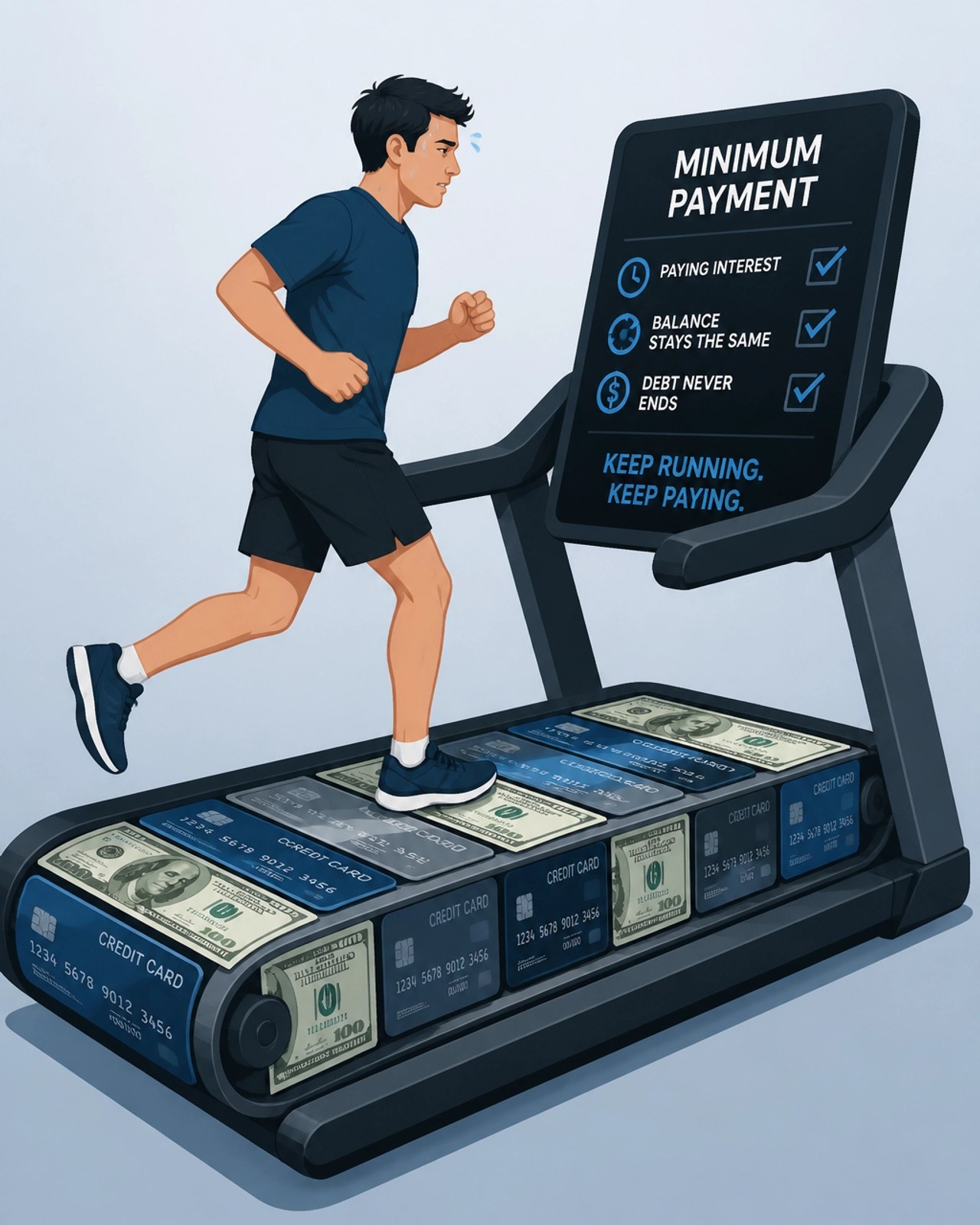
This is the most common trap in the book. You get your credit card statement, see a $5,000 balance, but the "Minimum Payment Due" is only $125. It feels manageable, so you pay it and move on.
The problem? Paying only the minimum is like trying to run a marathon on a treadmill that’s moving backward. Because of how interest is calculated, a huge chunk of that $125 goes toward the interest, not the actual debt. In some cases, it can take 20+ years to pay off a single balance if you only stick to the minimums.
How to Fix It: Awareness is your first weapon. Look at your statement, by law, they have to show you how long it will take to pay off the balance if you only pay the minimum. It’s usually a wake-up call. Aim to pay even $20 or $50 above the minimum. Every extra dollar goes directly toward the principal, which reduces the amount of interest you’re charged next month.
2. Ignoring the "Interest Vampire"
Interest rates in 2026 are no joke. Many credit cards now carry APRs north of 20% or even 25%. If you aren't looking at those rates, you are essentially letting an "Interest Vampire" bleed your bank account dry every single month.
When you ignore the rate, you lose the ability to prioritize. Not all debt is created equal. A 4% mortgage is a completely different animal than a 28% store credit card.
How to Fix It: List out every debt you have, from highest interest rate to lowest. This gives you a clear target. You don't necessarily have to pay them all off at once, but you should know which ones are costing you the most to keep around. Education on interest awareness is the first step to stopping the bleed.
3. Delinquency Denial
With auto and credit card delinquency rates hitting 16-year highs this year, many people are choosing the "Ostrich Strategy", sticking their head in the sand and hoping the problem goes away.
Ignoring a late payment or a collection notice doesn’t make it disappear; it makes it more expensive. In Maryland, debt collection practices can be aggressive. Once a debt moves into the legal or collection phase, your options for negotiation shrink, and the fees start to stack up.
How to Fix It: Face the mail. If you’re falling behind, the best thing you can do is seek education on your rights and the status of your accounts. Knowing exactly where you stand with your creditors allows you to make informed decisions rather than reactive ones.
4. Using Credit to Fill the Lifestyle Gap

Many households use credit cards to bridge the gap between their income and their lifestyle. Maybe it’s a dinner out, a new gadget, or even just groceries because the checking account is low.
When you use debt to fund daily life without a plan to pay it back immediately, you’re essentially borrowing from your future self. You're trading tomorrow’s freedom for today’s comfort.
How to Fix It: This mistake usually points to a need for better cash flow awareness. Instead of reaching for the plastic, ask: "Do I have the cash for this?" If the answer is no, it’s an opportunity to review your household budget and see where your money is actually going. Small shifts in awareness can lead to big changes in debt habits.
5. The 84-Month Auto Loan Trap
Cars are more expensive than ever, and to make the monthly payments "affordable," many lenders are pushing 72-month or even 84-month loans.
While the monthly payment looks small, a 7-year loan on a depreciating asset is a recipe for "negative equity." This means you owe more on the car than it’s worth for almost the entire life of the loan. If you need to sell the car or if it gets totaled, you’re stuck with a "gap" you have to pay out of pocket.
How to Fix It: When shopping for a vehicle, look at the total cost of the loan, not just the monthly payment. Be conservative with your targets. A shorter loan might mean a higher monthly payment, but it also means you’ll actually own the asset sooner and pay significantly less in interest over time.
6. The "Invisible" Debt-to-Income (DTI) Ratio

Your Debt-to-Income ratio is a number that lenders use to decide if they’ll give you a mortgage or a business loan. Many people have no idea what theirs is until they get rejected for a loan they really need.
If more than 36-43% of your gross monthly income is going toward debt payments, you are in the "danger zone." This high DTI makes you a "risky" borrower, which usually leads to higher interest rates on future loans: creating a cycle that’s hard to break.
How to Fix It: Calculate your DTI today. Add up all your monthly debt payments (rent/mortgage, cars, credit card minimums, student loans) and divide that by your gross monthly income. If the number is high, your goal shouldn't just be "paying off debt," but "lowering your DTI." This creates the clarity needed to improve your financial standing.
7. The "Lone Wolf" Strategy
The biggest mistake of all? Trying to figure it all out by yourself. Financial education isn't taught in most schools, yet we're expected to navigate complex interest rates, tax awareness, and credit education on our own.
Many people feel a sense of shame about their debt, so they keep it a secret. They try to out-earn their bad habits, but without a fundamental shift in financial education, the cycle usually repeats.
How to Fix It: Seek resources. There is a whole world of financial education designed to give you clarity on credit, taxes, and debt. You don't have to be a math genius to master your money; you just need access to the right information and a clear path forward.

Moving Forward with Clarity
Debt doesn't have to be your identity. It’s just a financial state, and states can change. By avoiding these seven common mistakes, you’re already ahead of the curve.
The goal isn't just to "get out of debt": it's to gain the education and awareness so that you never end up back in the same cycle. Whether it’s understanding how your credit works, becoming more aware of your tax obligations, or learning how to negotiate your monthly bills, every bit of knowledge adds up to more freedom.
At K-Stone Enterprises, we are committed to being your liaison to the resources that help you move smart with understanding and clarity.
Want this kind of insight every week? Join the Inner Circle — it's free and it keeps you ahead of the curve.
Review the information here when ready: www.mwrfinancial.com/krnrstn21
Want me to send you the information so you can review how it works?
🧵 Check out Twisted Emotions (Threaded Creations KLM) on Etsy — unique, handcrafted apparel that lets you wear your story. Browse the shop here: https://threadedcreationsklm.etsy.com
Leave a Reply