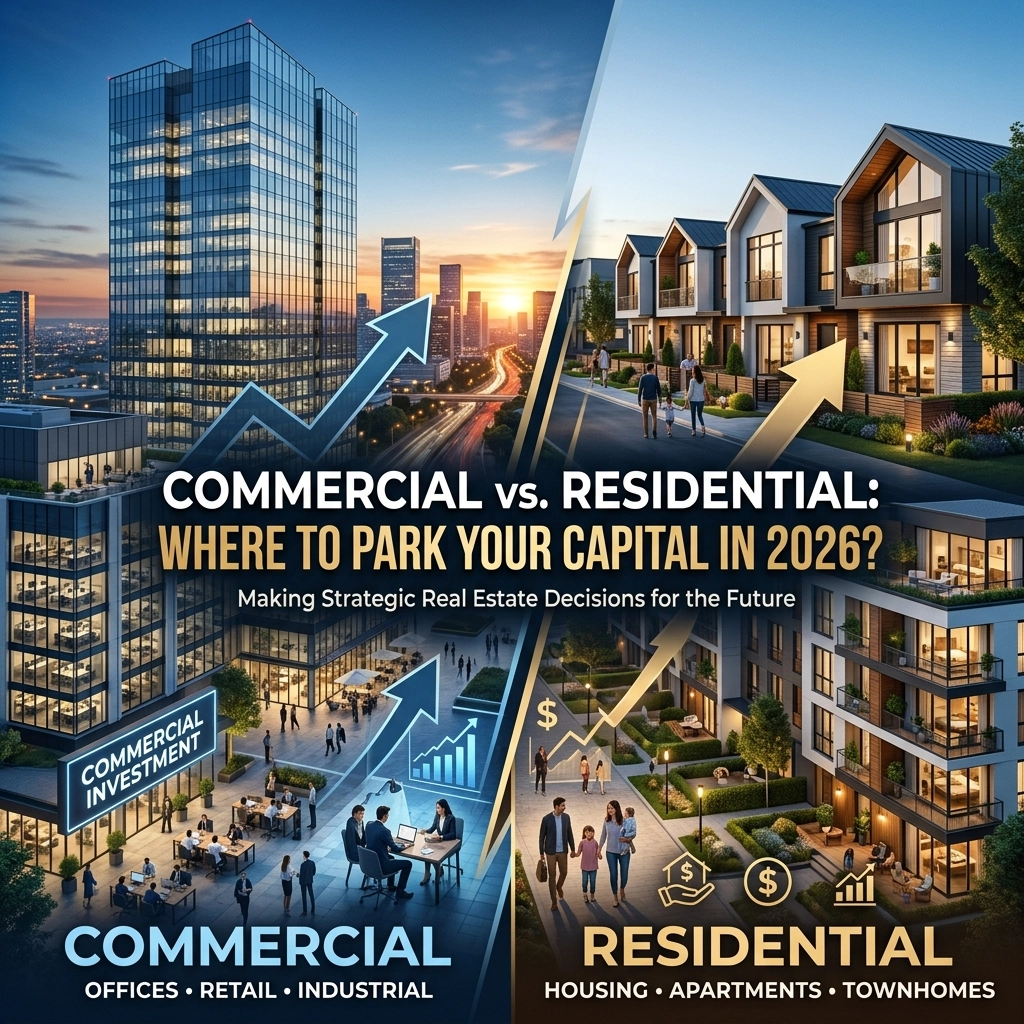
It’s May 2026, and if you’ve been looking at your portfolio lately, you probably feel that familiar itch. The market isn't what it was two years ago. We’ve moved past the "wait and see" phase of high interest rates and entered a period where the tax man is getting significantly more creative: especially here in Maryland.
If you’re sitting on capital and trying to decide between the reliability of residential property or the high-stakes yield of commercial real estate, you’re asking the right question at a very complicated time. Between Maryland’s updated high-income tax brackets and the state’s current ranking as one of the toughest places in the country to do business (clocking in at #49 according to the 2026 WalletHub study), "where" you park your money is just as important as "how" you protect it.
Let’s break down the 2026 landscape so you can move with confidence.
The Residential Safe Haven: Why the "Roof" is Still Winning
In 2026, the residential market remains the "old faithful" for a reason. While the "flashy" money often looks at skyscrapers, the "smart" money is looking at single-family rentals and multi-family units.
Why? Because demand hasn't just stayed steady; it has intensified. As of May 2026, real estate stats for key Maryland hubs like Annapolis show a median sale price of approximately $622,000. With a market pace that sees homes moving in under 35 days, the liquidity of residential assets is significantly higher than commercial.
1. Stability in the "Squeeze"
We are seeing a 24.5% projected appreciation rate through 2030 for residential assets. Even with the rising BGE distribution rates (which hit nearly 98 cents per therm this spring), residential tenants are proving more resilient than small retail businesses. People will cut their "extra" spending before they stop paying for the roof over their heads.
2. Lower Barriers to Entry
Financing a residential deal in 2026 still typically requires a 20-25% down payment. Compare that to the 35-40% often required for commercial ventures in today's tighter lending environment. If you’re looking to leverage your capital across multiple doors rather than one big building, residential is your playground.

The Commercial Pivot: Yields, Risks, and Niche Gold Mines
Commercial real estate in 2026 is a tale of two cities. The traditional office space is still licking its wounds from the hybrid-work revolution that refused to die. Office investment activity is down 3% this quarter, and retail isn't faring much better with an 11% dip.
However, if you know where to look, commercial offers yields that residential can’t touch: often in the 6-10% range.
1. The Rise of "Essential" Commercial
While "Class A" office space is struggling, niche commercial sectors are exploding. Data centers, senior housing, and industrial "last-mile" warehouses are the gold mines of 2026. As Maryland continues to be a tech-heavy corridor, these assets are becoming the backbone of institutional portfolios.
2. The Maryland Business Factor
We have to be real: Maryland is currently ranked 49th for starting a business due to labor costs and office affordability. This makes traditional commercial leasing a "landlord's battle." If your tenants are struggling to keep their doors open because of the state's regulatory environment, your cash flow is at risk. This is why commercial investors in 2026 are focusing on "triple-net" (NNN) leases where the tenant handles the taxes, insurance, and maintenance.
The 2026 Tax Trap: Maryland’s New Reality
Regardless of whether you choose a condo or a warehouse, the 2026 tax landscape in Maryland is designed to take a bite out of your gains. We are currently navigating new high-income tax brackets and a 2% capital gains surtax that was recently implemented.
If you aren't using a "Tax Shifting" strategy, you aren't just losing money to the market; you're handing it over to the state. This is where wealth management meets real estate. Parking $500k in an asset that grows 10% is great, but if 40% of that gain is eaten by state and federal taxes because your "structure" is wrong, you’ve effectively lost.

How to Get "Investor Ready" in 2026
The biggest mistake investors make: whether they're buying a duplex in Baltimore or a strip mall in Bethesda: is going in without a "Funding Prep" strategy.
In a market where Maryland lenders are being more cautious, you can't just walk in with a high credit score and a smile. You need a package that speaks the bank’s language. This is exactly what I specialize in through our Paid Funding Preparation Service.
If you’re serious about parking capital this year, you shouldn't be doing your own homework. Our "Investor Ready" package includes:
- Detailed Deal Analysis: We don't guess; we calculate.
- ARV Comps & Rehab Budgets: Real numbers based on 2026 labor and material costs.
- Loan Submission Packages: Professional-grade submissions through our Real Brokerage lending partners to ensure you get the best rates available in today’s climate.
Don't let a "maybe" deal kill your capital. You can check out our specialized property analysis tools and listing resources at Millis Property or see how we leverage the power of the Real Brokerage to get deals across the finish line.
Comparison Table: 2026 Strategy at a Glance
| Feature | Residential (2026) | Commercial (2026) |
|---|---|---|
| Average Yield | 3 – 6% | 6 – 10% |
| Risk Level | Low to Moderate | High (Sector Dependent) |
| Liquidity | High (35-day average) | Low (6-12 months) |
| Down Payment | 20 – 25% | 35 – 40% |
| MD Tax Impact | Significant (Property Tax) | High (Business Surcharges) |
The Verdict: Where Should You Park?
If you are looking for legacy and stability, residential is your winner. The 2026 housing shortage in Maryland isn't going anywhere, and the appreciation stats back it up. It’s a "buy and hold" dream.
If you are looking for aggressive cash flow and have the stomach for a 49th-ranked business climate, certain commercial sectors (Industrial/Senior Living) offer the highest returns. But: and this is a big "but": you better have your deal analysis ironclad.
If you're ready to move on the right deal in 2026, start with a stronger strategy and a cleaner underwriting package.
Connect with Millis Property for deal support, property analysis, and investor guidance:
https://lmilbourne9.wixsite.com/millisproperty
Explore financing and brokerage support through Real Brokerage:
https://onereal.com/lamont-milbourne
Tweet for Sonny:
"Commercial vs. Residential in 2026: Maryland is currently the 49th toughest state for business. Do you know where your capital is safest? 🏠🏢 We're breaking down the data, the taxes, and the 'Investor Ready' strategy you need right now. Read more: [Link] #RealEstate2026 #MarylandInvesting #CommercialRealEstate"
Leave a Reply